
Lafayette County VINELink Coverage
Florida VINE on VINELink is a custody-status and notification service. Florida materials describe monitored populations that include county jails, Florida Department of Corrections facilities, Community Corrections, and juvenile justice. The Lafayette County Sheriff victim-services page helps route local case-status and referral questions, and the Sheriff links to VINELink from its resource menu. It does not publish a county-specific participation guarantee, update schedule, or list of events.
That distinction matters. Search results depend on data supplied by a participating agency. A Lafayette County Jail result concerns local jail custody. An FDC result concerns state prison or community supervision. VINELink is most useful while the correct person is still shown, since an alert can be registered before a change. After an event, a released or out-of-custody status can corroborate the agency’s report, but it is not a certified release document.
- Custody status
- The broad state reported for the person, such as in custody or released.
- Custody detail
- Added agency information that may describe the present status or event.
- Transfer
- A move from one agency or facility to another, not necessarily freedom from custody.
- Release alert
- A notice sent after a contributing system reports a selected custody event.
Search Lafayette County on VINELink
Begin with the Florida page and select “Search for Someone.” Choose the offender or defendant search. Guest users may need to complete a CAPTCHA. The live interface may offer partial-name or ID options, and a photograph can appear when the reporting agency supplies one. Never rely on a shared name alone.
- Open Florida VINELink and choose the search for a person.
- Select Name or ID Number. Enter the most exact identifier available.
- Review all plausible results. Compare the full name, offender or booking ID, agency, facility, photograph, custody status, and custody detail.
- Open the correct detail. Note which agency supplied the record before interpreting the result.
- If the result says released or out of custody, record the status detail but ask whether another agency received the person.
- If no record appears, check spelling and identifiers, then contact the believed facility rather than treating the miss as proof of release.
The manifest capture from the official Florida VINELink sequence shows the name-or-ID search, a historical release result, notification choices, the PIN screen, and confirmation:
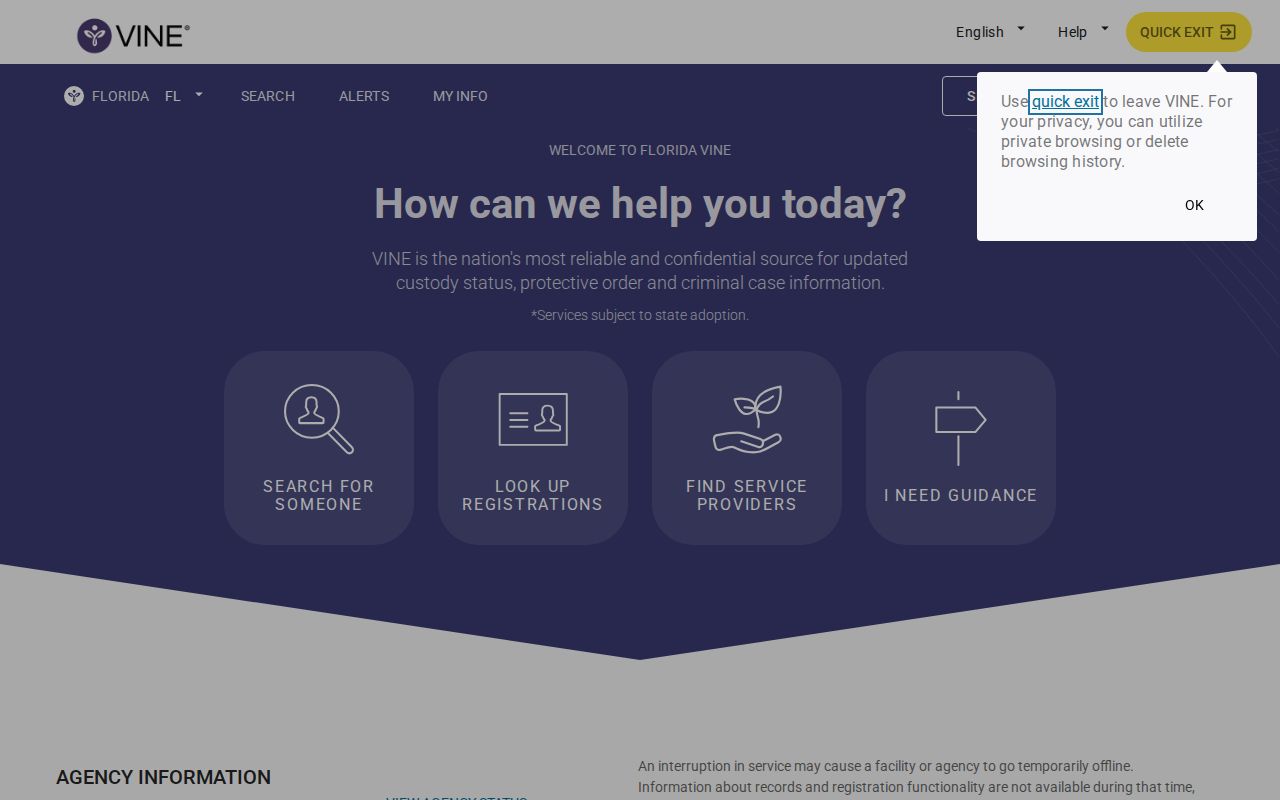
The sequence shows why the agency and identifier must be checked before notification. Each screen belongs to one selected record, not to a countywide release list.
Note: A no-match can result from spelling, scope, agency participation, transfer, or processing lag and does not establish release.
Lafayette VINELink Release Fields
Available details vary by contributing agency and record. VINELink does not promise the same field set for every Lafayette County Jail or FDC record. Treat each displayed label literally. A status date can reflect an agency update without proving the time a person passed through the jail exit.
| VINELink field | What it helps confirm |
|---|---|
| Name | Starts the identity match but needs another identifier. |
| Offender or booking ID | Separates people with similar names and links the notice to one record. |
| Agency or facility | Identifies which custody system supplied the status. |
| Custody Status | Shows the broad current or reported custody state. |
| Custody Detail | May add release, transfer, location, or other agency-specific context. |
| Status or event date | Places the reported change in time, subject to agency update lag. |
| Photograph | Can aid the match when the reporting agency provides one. |
A released status means the contributing agency reported the end of its custody event. It does not answer whether probation or another form of supervision continues. It also does not rule out transfer to another county, FDC, a federal authority, or immigration custody. For the full Lafayette search sequence across agencies, use the Lafayette County released-inmate search.
Register Lafayette Release Alerts
Open the correct record before choosing “Get Notified.” The offered methods depend on the record and current configuration. Florida materials identify phone, text, email, TTY, and in-app options, along with events such as release, transfer, escape, and death. Follow the live prompt for the method selected.
- Select “Get Notified” from the correct person’s detail.
- Choose an offered method and enter a direct phone number, email address, or other destination.
- Select the offered event types that fit the custody question.
- Continue to “Next: PIN.” Create and re-enter a memorable four-digit PIN so both entries match.
- Save and confirm the registration. Basic anonymous registration does not require an account.
- If an account is created, verify it with the code sent by text or email so registrations can be managed.
- For a VINE call, enter the four-digit PIN followed by the pound sign to confirm receipt and stop repeat calls for that event.
Unanswered calls may repeat for up to 48 hours. Avoid registering a switchboard that may not reach the intended person. Multiple direct contact methods can be used when offered. If a PIN is forgotten, Florida VINE can be reached at 1-877-846-3435, also written as 1-877-VINE-4-FL, through the operator option.
Florida materials state that registration is confidential and the offender is not told who registered. Current prompts may require a PIN for text service as well as calls. The safest practice is to follow the live screen for the chosen channel rather than assume every method uses the same confirmation steps.
Lafayette VINE and Sheriff Records
The local layer has two distinct parts. The Lafayette County Sheriff points readers toward VINELink, while the jail and records custodian remain responsible for Lafayette’s underlying custody record. The Sheriff does not publish an online roster or recent-release feed, and it gives no local promise about how fast a VINE event appears.
For an immediate check, call Lafayette County Jail at 386-294-4381 and ask whether the named person is held, released, or transferred. Its official jail page supplies the facility route but no public roster. For documentary proof, use the Sheriff’s public-records channels and request the booking number, booking time, actual release date and time, release disposition, and receiving agency when public. A VINE notice can be preserved as evidence of the alert, but the Sheriff entry supplies the local event detail.
The Florida VINE monitored-population explanation illustrates the statewide notification layer:
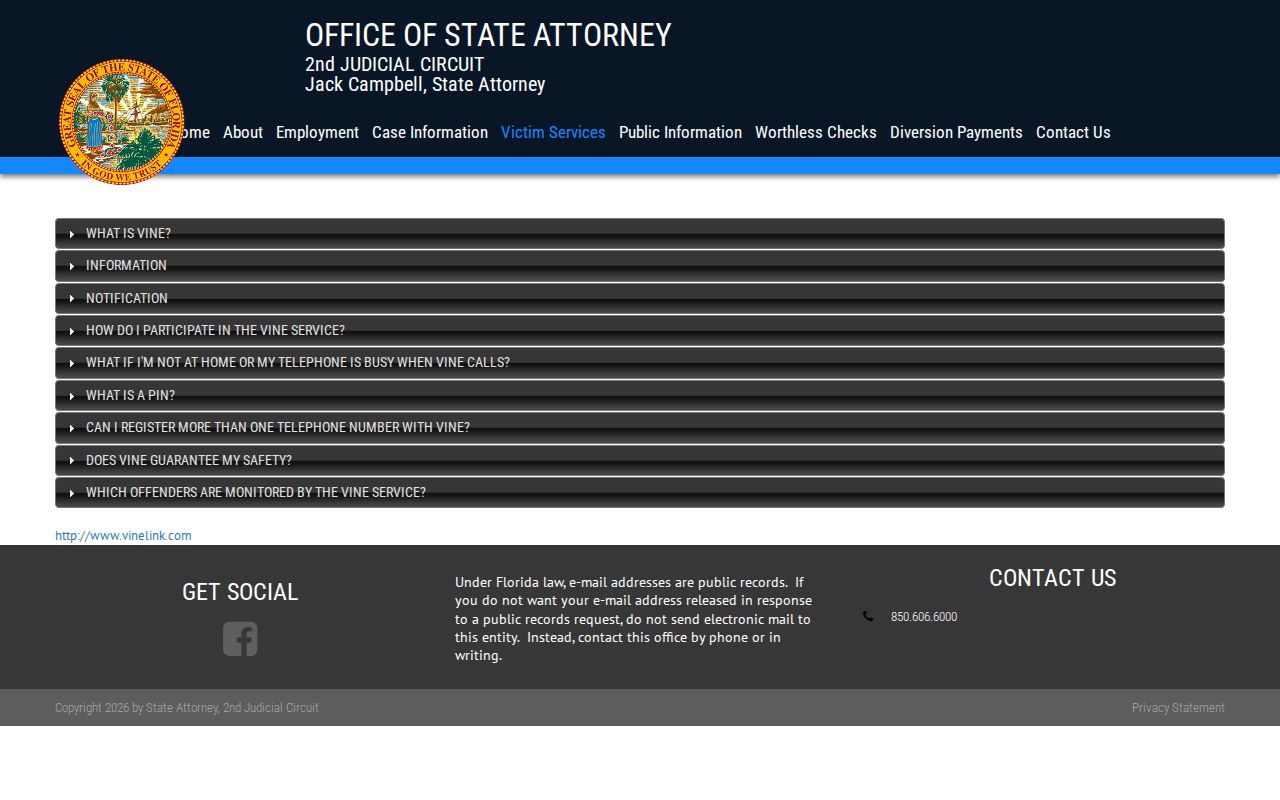
The statewide description helps define scope. It does not establish that every Lafayette event or field appears on a fixed schedule.
Lafayette Release Alert Response
A VINE notice should trigger a source check, not an assumption about the person’s final location. Read the event type and the reporting agency first. A transfer notice means custody may continue elsewhere. A release notice means that agency reported its custody ending, but another hold or supervision status can still apply. Save the message details and note when it arrived, since notification time may differ from the agency event time.
Then contact the responsible office. For a Lafayette County Jail event, ask the jail whether the record shows community release or transfer and request the release disposition. For an FDC event, compare the current, released, and supervised population searches. When a court order appears relevant, the Lafayette Clerk docket may show bond, dismissal, sentence, or another judicial act, while the custody agency remains the source for the physical release timestamp.
VINE is not a safety guarantee. Florida’s system permits confidential registration, but a status alert cannot predict conduct or replace an emergency plan. If an immediate safety issue exists, use emergency services. For routine custody verification, keep the inquiry tied to the named record, the event, and the agency that supplied it.
Lafayette Release Systems Compared
Mayo contains both Lafayette County Jail and Mayo Correctional Institution Annex, but they belong to separate custody systems. The Sheriff controls the county booking-and-release record. FDC controls the state-prison record. A jail transfer to Mayo Annex is not a community release even though Lafayette jail custody ended.
| Situation | Primary confirmation | VINELink role |
|---|---|---|
| Lafayette jail release | Sheriff booking-and-release record | Specific-person alert or status corroboration |
| Transfer from jail to FDC | FDC current inmate search plus Sheriff disposition | May report a transfer event |
| Release from Mayo Annex | FDC Released Inmate Search | Notification or custody-status layer |
| Community supervision | FDC Supervised Population Search | Does not replace supervision details |
| Federal BOP release | BOP Inmate Locator | Outside VINELink’s federal scope |
The FDC offender-search menu separates inmate population, released inmates, supervised population, and absconders. Select the route that matches the question. A future “Current Release Date” on an inmate detail is not proof that departure occurred. After the event, use the FDC released record and its Release Date or Date Out-Custody fields.
Note: One agency’s reported release can coexist with another agency’s custody, so always identify the reporting and receiving agencies.
Lafayette VINELink Release Limits
VINELink relays agency data. It is not an independently adjudicated record, a safety guarantee, a complete county release list, or a federal locator. Updates can lag. A result may be absent because an agency does not participate, an identifier is wrong, a transfer is still processing, or the record falls outside the service’s scope.
Confirm with the source: Use the Lafayette Sheriff record for county custody, FDC records for state custody, and the BOP locator for federal sentences.
The BOP Inmate Locator can show a past federal release date and a released or not-in-BOP-custody result. ICE’s locator is designed for current immigration detention, not a historic release archive. Neither system should be replaced with a VINELink search. Likewise, a Clerk docket can explain the court act behind a Lafayette release but may not contain the jail’s actual departure time.
When VINE, a court entry, and an agency record disagree, contact the agency that held or released the person. Ask for the event time, disposition, and transfer destination when public. That narrow check resolves the status without stretching VINELink beyond the role it performs.
Note: A VINE notice should prompt agency confirmation when the release reason, precise time, or receiving authority matters.