
Lafayette 72 Hour Release Status
No official Lafayette County three-day release feed exists. The Sheriff’s Jail Information page publishes contact routes, not a roster or recent-release page. Florida’s statewide county-jail directory also gives Lafayette County Jail’s contact details without the inmate-search link shown for counties that operate a public search.
The correct result is not an empty list. An absent feed cannot reveal whether the jail processed no releases or several. It also provides no public cadence, field set, photograph policy, or online retention period. The useful substitute is an existing Sheriff report for a defined span, if maintained and public, or the individual booking-and-release entries within that span.
Three-day caution: A wider date range can find more events, but it does not turn an unavailable Lafayette feed into a public archive.
Request Lafayette Three-Day Releases
Define the period with start and end dates and times. “Last 72 hours” moves as time passes, which can lead to a different response on each day. A fixed interval gives the Sheriff’s records custodian a clear range and makes later review easier. Ask first for an existing commitment-and-release list or release log in its existing format.
- Write the start and end of the interval, including the time zone if needed. A midnight-to-midnight range is often easier to state than a moving window.
- Contact the Sheriff through its public-records page by phone, email, office delivery, or mail.
- Ask whether an existing jail release log or Commitment and Release List covers that span. Request the existing record rather than a new custom analysis.
- If no interval report exists, request the existing booking-and-release entries for the period, subject to lawful limits and redactions.
- For a specific person, call Lafayette County Jail and compare the event with VINE and the Clerk docket.
The Sheriff may provide an estimate before chargeable extensive work. Chapter 119 supports inspection and copying of public records, but it generally does not require an agency to create a report it does not maintain. A focused request is more useful than asking staff to research every possible interpretation of “release.”
Note: Fix the interval before sending a request so the same three-day window can be reviewed and verified later.
Lafayette 72 Hour Record Fields
Lafayette County publishes no online field display, so these are fields to seek in the existing Sheriff record. Not every field is guaranteed to exist or be public. The booking number is especially useful because a name may appear in more than one custody episode. The release type and receiving agency keep a transfer from being misread as a community release.
| Requested field | How to read it |
|---|---|
| Name and booking number | Identifies the person and the exact jail episode. |
| Booking date and time | Shows when the reviewed Lafayette custody began. |
| Release date and time | Places the custody-ending event inside or outside the set window. |
| Release disposition | May identify bond, court order, dismissal, sentence completion, or transfer. |
| Holding or receiving agency | Shows whether another government agency took custody. |
| Bond details | Helps connect the jail event to the relevant court order. |
Charges recorded at booking are not the final court outcome. Use the Lafayette Clerk records gateway and the county 34 CiviTek search to review docket events, bond orders, disposition, sentence, dismissal, or probation. The docket may explain why custody ended, but it may not state the physical hour of departure.
Lafayette Weekend Release Checks
A three-day span is helpful when the event may have occurred during a weekend or when the search begins after one business day has passed. Yet Lafayette County has no published weekend feed, holiday schedule, or update cadence to consult. Do not claim that a list resets at midnight, holds entries for three days, or posts after a set delay. None of those local rules is documented.
The jail itself operates continuously, and its line is answered around the clock. For a person-level question, call 386-294-4381 and ask whether the record shows current custody, release, or transfer. Administrative and public-record processing follows separate office practices, so documentary follow-up may not arrive at the same pace as an urgent jail call.
VINE can add a timely custody-status event when the reporting agency supplies it. A court entry may show the order behind a bond or release. If the person was sent to FDC, the state’s current inmate record is the next source rather than the FDC released search. Transfer to state prison ends county custody but does not end physical custody.
Lafayette Release Archive Gap
The lack of a public roster, 24-hour view, and 72-hour view is the central local data quirk. The legacy JADES homepage is not a working release archive. A Lafayette Parish, Louisiana feed is from another state, while a similarly named sheriff app belongs to Mississippi. None can be substituted for a Florida Lafayette record.
The Sheriff’s official request channels show the available local path. The Lafayette public-records source documents phone, email, office, and mail options:
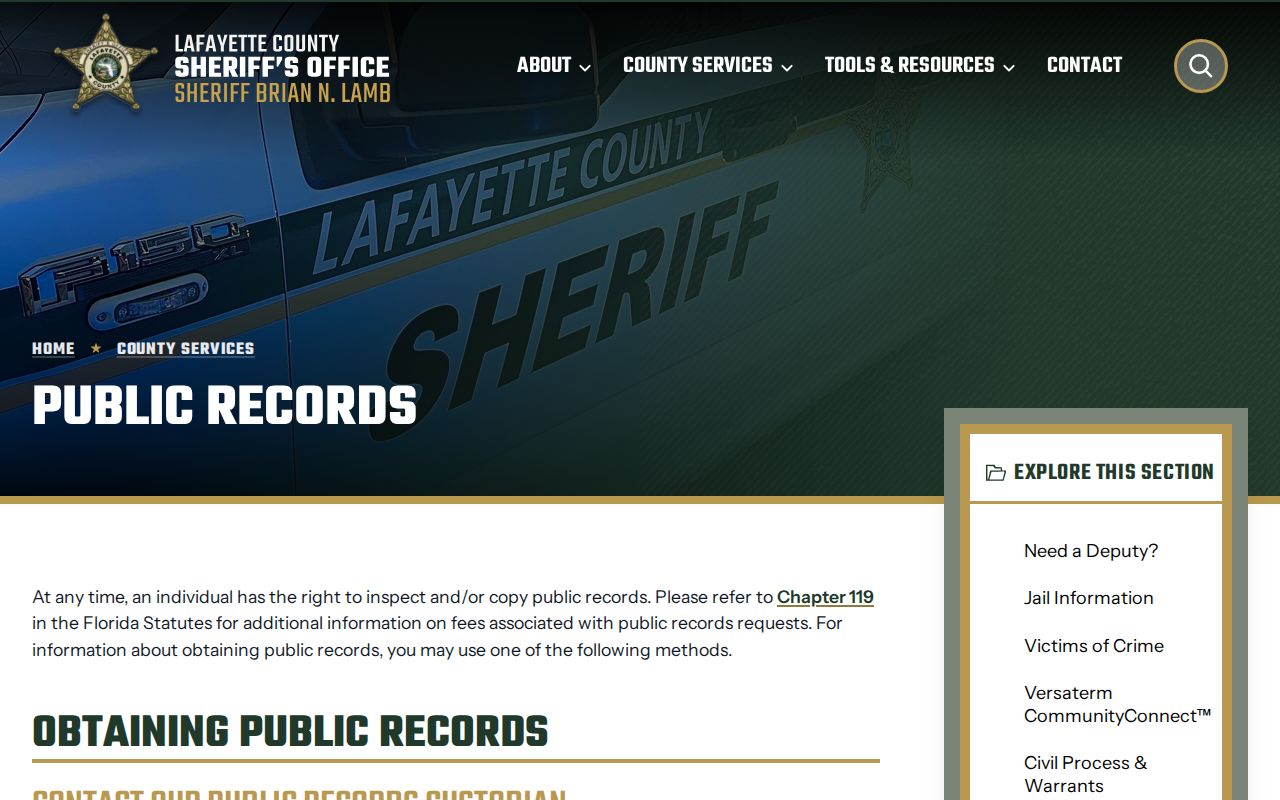
The image supports a records-first workflow, not a claim that a ready-made three-day list exists. If the Sheriff does not keep the requested format, narrow the request to existing entries and accept lawful redactions.
Note: A commercial or out-of-state page may supply a lead, but only Lafayette agencies can verify the county jail event.
Lafayette Named-Person Release Check
A date-range request asks which events occurred during the whole span. A named-person search asks what happened to one custody episode. Start by calling Lafayette County Jail. Then request that person’s booking-and-release record, including the release disposition and receiving agency. The home page’s Lafayette County released-inmate search lays out the full cross-system path.
Florida VINELink can show custody status and detail from a participating agency and can deliver a release or transfer alert. A no-match is not proof of release. Misspelling, agency participation, transfer, processing lag, or scope can cause a missing result. Formal confirmation comes from the agency record.
If the facts point to Mayo Correctional Institution Annex or another state prison, use the Florida Department of Corrections offender-search menu. Its inmate, released, supervised, and absconder searches answer different questions. The Lafayette Sheriff does not control an FDC discharge record, and FDC does not archive a jail-only Lafayette release.
Lafayette Release Source Comparison
Each source has a defined role. Combining them resolves common conflicts without treating any one search result as broader than it is. The Sheriff record establishes the Lafayette jail event; the court docket explains judicial action; VINE relays status; and FDC covers state corrections custody.
| Source | Best use | Main limit |
|---|---|---|
| Lafayette County Jail | Immediate current-custody, release, or transfer check | Telephone response is not the certified record |
| Sheriff public records | Timestamped booking-and-release documentation | No promised online three-day report |
| Lafayette Clerk docket | Bond, dismissal, judgment, sentence, and disposition | Not the physical jail release log |
| Florida VINE | Specific-person custody event and alert | Agency-fed data may lag or be incomplete |
| FDC Offender Search | State prison, release, or supervision status | Does not cover a jail-only stay |
For the narrowest same-day question, use the Released Last 24 Hours workflow. In either window, ask whether another agency received the person before describing the event as release to the community.
The Sheriff’s records route can also resolve a list-wide question that person-level portals cannot. VINE is designed around a selected person, and the Clerk docket is organized around cases. Neither is a substitute for an agency release log covering all Lafayette jail events in the fixed span. If the Sheriff maintains an existing list, its entries should still be read by disposition because transfers and community releases can share the same custody-ending date.
Retention presents a separate issue. Lafayette publishes no rule stating how long a name would remain online because it provides no online release view. An underlying record may be retained even though nothing appears on a public webpage. For an older three-day interval, give the exact dates and ask the records custodian to locate the existing series. Do not impose a 72-hour deletion rule that the county has never stated.
A jail event can also fall near a range boundary. If the exact hour is uncertain, request a small fixed span on both sides of the expected time and explain why. Then use the booking number and release timestamp to decide whether the event belongs in the intended three-day period. This is more reliable than guessing from the date of a later VINE alert or court docket entry.
Note: Keep the same start and end timestamps when comparing Sheriff, court, and VINE events across the three-day period.