
Lafayette Scheduled and Actual Release
A projected, tentative, current, or scheduled date looks forward. An actual release date records a completed custody event. FDC uses the public label Current Release Date on an active prisoner's detailed record. Florida law also refers to a maximum sentence expiration date and a tentative release date. These terms relate to one calculation, but they are not interchangeable with the historical Release Date and Date Out-Custody fields shown after a state-prison departure.
At Lafayette County Jail, a pretrial detainee has no sentence-expiration date. Release can turn on posted bond, dismissal, a judge's order, or the resolution of a hold. A person serving a county sentence may have a computed date, but the county jail does not publish that field online. A transfer to FDC, another county, or another agency ends one custody segment without proving release to the community.
Scheduled is not actual. Record a future date as changeable. Afterward, confirm Date Out-Custody with FDC or the actual release entry with the Lafayette Sheriff.
Find a Lafayette Projected Release Date
Start with custody level. Mayo Correctional Institution Annex is an FDC state prison. Lafayette County Jail is a Sheriff-operated county jail. Their records do not merge merely because both facilities are in Mayo. For a state prisoner, use the FDC Inmate Population Search. Match the six-character DC number, then read the detail's Initial Receipt Date, Current Facility, Current Custody, and Current Release Date. The page may also show “TO BE SET” during review or “SENTENCED TO LIFE” for a life term.
For a jail-only sentence, obtain the Lafayette judgment and sentence through the Clerk records gateway. Note the court-awarded credit for time already served. Then call Lafayette County Jail at 386-294-4381 or ask the Sheriff records custodian for the date it actually computed. Do not apply FDC's state-prison rule to a county sentence.
- Identify whether the person is pretrial, serving a county sentence, or committed to FDC.
- For FDC custody, search by DC number and record the exact Current Release Date label and warning.
- For a Lafayette jail sentence, get the judgment, sentence length, and specified jail credit from the Clerk.
- Ask the jail or records custodian for its computed date and whether any hold or transfer affects departure.
- After the date passes, confirm the actual release or receiving agency in the correct release record.
The official FDC detail source below illustrates where Current Release Date appears.
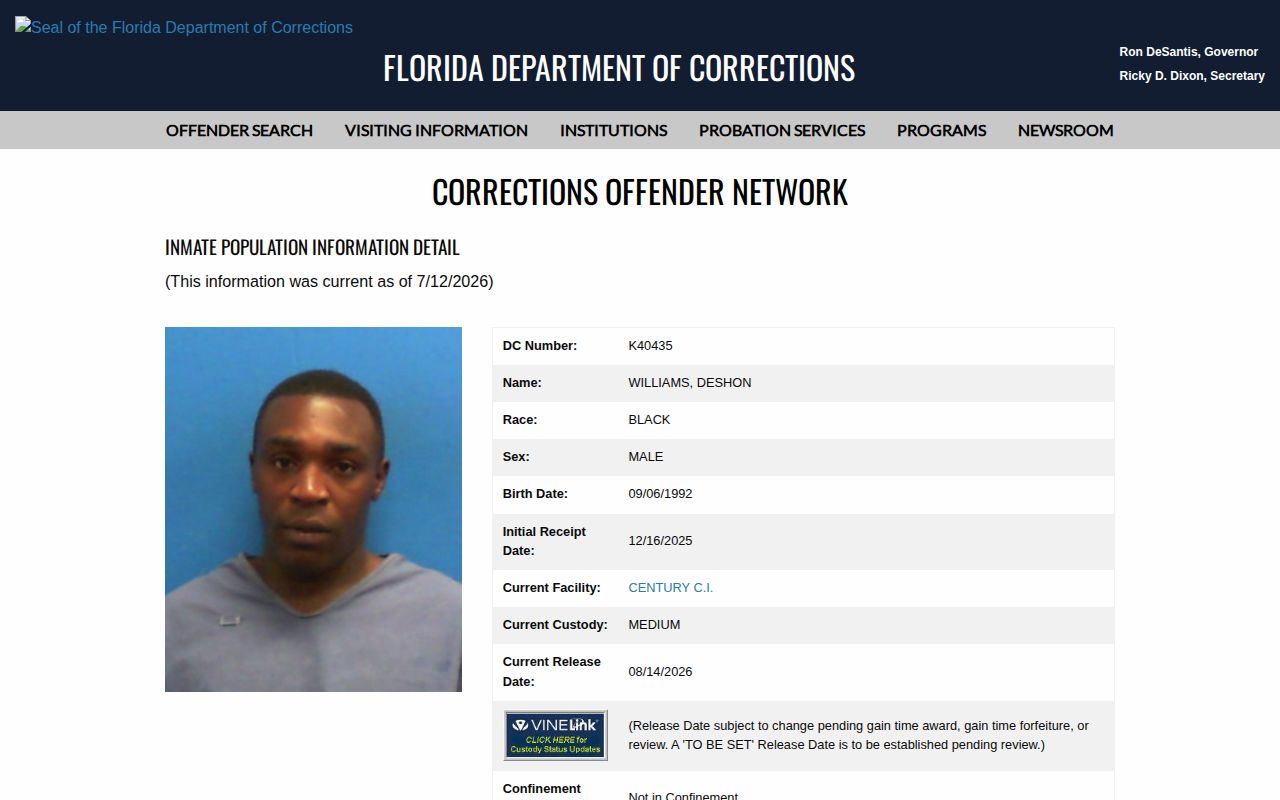
The image is a field example. It does not establish a date for a person held only at Lafayette County Jail.
Florida Prison Release Date Calculation
Florida Statutes section 944.275 directs FDC to calculate maximum and tentative release dates and governs basic and incentive gain-time. For covered offenses committed on or after October 1, 1995, FDC may award up to ten days per month of incentive gain-time. Yet gain-time cannot make an applicable prisoner serve less than 85 percent of the imposed sentence. Court-awarded credit for actual physical confinement counts toward that floor.
The common claim that a Florida prisoner automatically receives 15 percent off is wrong. Eighty-five percent is a service floor for applicable cases, not a guaranteed credit. Eligibility, conduct, offense date, statutory exclusions, sentence structure, and FDC review all matter. A life sentence does not gain an ordinary expiration date through this system. For that reason, the live FDC detail is stronger than arithmetic done from a sentence announced in court.
The official gain-time statute appears below as the controlling source for the state-prison rule.
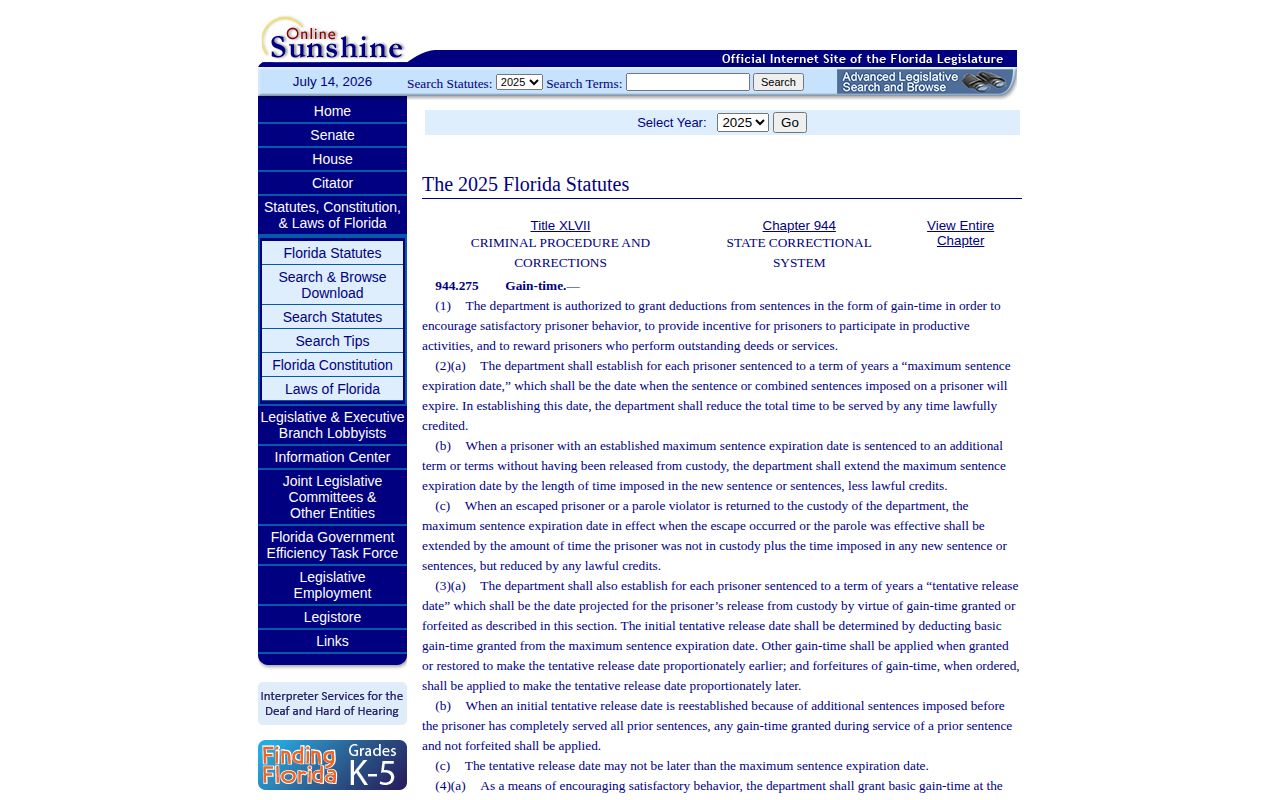
Its terms support FDC's changing tentative calculation, not a fixed promise made by a third-party calculator.
Note: Court-awarded jail credit can count toward the state rule, but FDC remains the source for the published calculation.
Lafayette Release Date Field Meanings
Several date labels may appear in one file, and each answers a different question. Initial Receipt Date marks the start of the state commitment shown on an FDC detail. Current Release Date is FDC's live, forward-looking field. Maximum sentence expiration date is the statutory calculation based on imposed sentences after lawful credits. Tentative release date reflects gain-time awards or forfeitures. Release Date and Date Out-Custody become the key historical fields after departure.
- Current Release Date
- FDC's public label for the changing date on an active prisoner's detailed record.
- Tentative release date
- A statutory projection that incorporates gain-time awarded or lost.
- Maximum sentence expiration
- The sentence endpoint FDC calculates after lawful credits, before other practical custody issues are resolved.
- Date Out-Custody
- A historical field showing actual departure from the FDC custody episode.
- Jail credit
- Time spent in confinement before sentencing that the court specifies as credit on the sentence.
A public field marked “TO BE SET” means review has not produced a current date. “SENTENCED TO LIFE” means an ordinary term-expiration field does not apply. Neither phrase should be converted into a guessed calendar date. Call FDC Admission and Release if a detail remains unclear or appears inconsistent with the signed judgment.
Lafayette Jail Release Date Credits
The FDC 85-percent framework does not control every jail-only Lafayette sentence. Under section 921.161, the sentencing court credits time already spent in county jail and states that credit in the sentence. Section 922.051 permits county confinement for cumulative terms of one year or less in specified cases. Those records define the starting point.
Section 951.21 provides a county-prisoner good-conduct framework unless the county commission lawfully discontinues or revises it. It allows up to five days per month in years one and two, ten days per month in years three and four, and fifteen days per month after that. It also permits up to five days per month of meritorious good time on a sheriff or warden recommendation. Credits may be forfeited.
No verified Lafayette-specific public calculation policy was located. That gap prevents a safe do-it-yourself date. Ask for the jail's actual computed date and its applicable policy rather than assuming the statutory maximum was earned. A short county term can also end through a court event or hold that simple subtraction misses.
The county-prisoner gain-time statute is captured below.
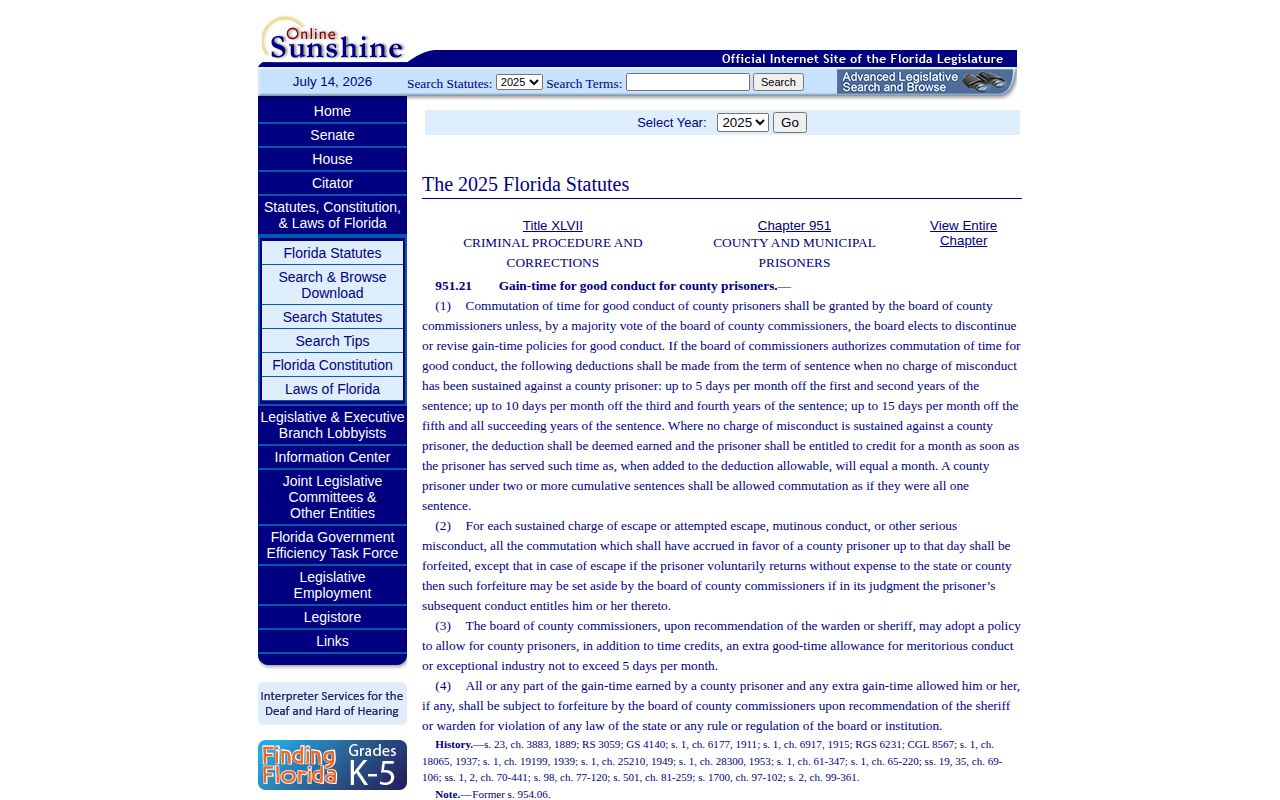
The statute frames possible credit, while the Lafayette judgment and jail computation establish the person-specific date.
Why Lafayette Release Dates Change
A future date can move earlier, move later, or remain unset while an agency reviews the record. The FDC detail itself warns that gain-time awards, forfeitures, or review may change Current Release Date. Court action and custody held by another agency can also alter the practical result. Each factor has a different source.
| Factor | Possible effect | Best verification source |
|---|---|---|
| Gain-time award | May move an eligible computed date earlier within legal limits | FDC detail and central records |
| Disciplinary forfeiture | May move a tentative date later | FDC calculation |
| Corrected jail credit | Changes time counted toward the term | Court order and agency record |
| Concurrent or consecutive terms | Changes how multiple sentences combine | Judgment and FDC record |
| Appeal or later court order | Can revise the sentence or credit | Lafayette docket and signed order |
| Detainer or transfer | One custody may end while another begins | Releasing and receiving agencies |
| Parole or conditional review | May authorize, delay, alter, or revoke a planned release | FCOR written action and FDC status |
A detainer is a request or legal basis for another agency to take custody. It does not always change the sentence-expiration math, but it can change where the person goes on that date. Ask for the receiving agency or transfer destination in a release-record request.
Note: A computed date can remain accurate for one sentence even when a detainer changes the person’s next custody location.
Lafayette Release Date Record Channels
The office that owns the date depends on the sentence. FDC Admission and Release answers state-prison release-record questions at 850-488-9167 or dc.release@fdc.myflorida.com. FDC Central Classification handles inaccurate offender information and central records at 850-488-9859. When the future date leads to community supervision, the supervised-population search and Field Services at 850-717-3444 can show whether a new supervision phase began.
For a Lafayette jail term, the Sheriff records office can provide the booking and release entry at 386-294-1222 or DDennis@LafayetteSO.org. The Lafayette Clerk holds the signed judgment, sentence, court-awarded jail credit, and later docket orders at 120 West Main Street, Mayo, Florida 32066. Its public hours are Monday through Friday from 8:00 a.m. to 5:00 p.m. The Clerk record explains the legal sentence, while the Sheriff record establishes the local custody event.
If parole or conditional release affects an FDC date, FCOR's public schedule shows proceedings but not final results. Request the written action sheet at fcorlegal@fcor.state.fl.us or 850-848-4460. Compare it with the FDC record after action. This three-record check prevents a hearing date, planned release, or supervision start from being reported as the actual day a person left custody.
A federal or immigration hold calls for another system. BOP records apply to federal prison terms, and the ICE locator reports current ICE detention rather than a historical release list. Neither one should replace the Lafayette or FDC date when the person never entered that agency's custody.
Formal records requests should identify the committed name, aliases, DC or booking number, birth date only when needed to separate similar records, and a focused custody range. For FDC, ask for existing admission, release, incarceration-history, and detainer-cancellation records. For the Sheriff, ask for the commitment-and-release entry, calculated date, actual release time, release method, and receiving agency. A narrow request is easier to match and less likely to mix separate custody episodes.
FDC reviews confidentiality under section 945.10 and other exemptions. It need not create a new calculation or conduct research in response to a public-record request. The Sheriff likewise may redact exempt material. Ask each custodian to cite the basis for withheld content and provide the nonexempt remainder. The goal is the agency's existing date record, not a new prediction made for the requester.
Confirm Lafayette Actual Release Dates
For an FDC prisoner, return to the Released Inmate Search after the event. Release Date and Date Out-Custody show the historical departure. If supervision begins, the supervised-population record may show a matching Supervision Begin Date, the status, type, and assigned location. The current-inmate record is no longer the right place once the person has left prison.
For Lafayette County Jail, call the jail and request the existing commitment-and-release entry from the Sheriff. Ask for actual release date and time, method or disposition, and any receiving agency. The main jail line is answered around the clock, while administrative records staff work Monday through Friday from 8:00 a.m. to 5:00 p.m. and close from noon to 1:00 p.m. The Sheriff posts no fixed turnaround or local release-record price.
Florida VINE can provide a pending custody alert when the contributing agency sends the event. The VINELink Release Check explains person matching and registration. Use the notice as a prompt to confirm, not as a certified release record. VINE cannot show whether another agency took custody at once.
Note: After the expected day, replace the projection with an actual agency release entry or Date Out-Custody field.